In November of 2010, almost four years ago, I wrote a post describing what I thought at the time was the inevitable future of MMO's. The original post was taken down when I changed blogging sites, but digging through my writing archives, I managed to find it. It was written back in a time where I actually wrote all of my stuff offline, and then published it online - crazy, right? This week, we learned that Blizzard has canceled their most ambitious MMO project to date - Titan. There's been quite a bit of press this week speculating that this move marks the end of the MMO as we know it. I don't necessarily disagree. I won't say the MMO is dead, by any means - but the nature of it, is changing. You need look no further than Destiny to see where the genre is headed.
And looking back at the post I wrote four years ago, I think I got pretty close. What do you think? Here's the original post, unedited.
Thursday, September 25, 2014

Friday, August 8, 2014
Mobs you Respect

So I've been playing some Final Fantasy XIV a bit lately, and overall having a great time. One of the things I enjoy is a return to zones that have some genuinely rough monsters, mixed in with the fodder. And it got me to thinking, over the course of all the MMO's I've played - what are some of the mobs that have really earned my respect! And it seemed like a fun topic for a blog, so there you are.
Wednesday, March 5, 2014
Why are there no tanks?

So this line of thought got kicked off actually a few weeks ago, when I saw this blurb, from the letter from the producer for Final Fantasy XIV - ARR, in response to the question What can they do about the continued lack of tanks in the game?
We review player data every day, and recently there are actually a significant number of players leveling tank classes. When participating in the low level duty roulette, for example, you'll encounter players leveling their tanks and even players that just started a tank class. The number of tanks around level 40 is growing as well, and I believe this number will continue to increase. However, as you all know, there are also a number of players who are simply leveling a tank class because it's easier to queue in the duty finder, so whether or not these players will continue to play as tanks in the long term is still an issue. As things stand now, however, the number of tanks is growing, and I'm sure there are many players who will find tanking to be fun and continue leveling them up, so we're going to keep an eye on how many decide to use their tanks as their main class. If tanks are still in short supply, we would like to consider adding various bonuses such as a specialized mount.
And quite honestly this just flumoxed me. The need for tanks is so great in Final Fantasy that the producers of the game are considering bribing people to roll up tanks with specialized mounts. And Final Fantasy XIV certainly isn't alone in this. WoW has stuck with a strong role combat model (that is, a model that incorporates the oft referred to trinity of tank, dps, and heals) for over a decade, and it still struggles with a lack of tanks in random group play. And if it's not tanks, then it's healers. And it struck me - we've been doing this for over 20 years. Why isn't this a solved problem yet?
Wednesday, December 12, 2012
Hidden Garden - A Design Perspective

So a few weeks ago I posted up a bit of a story on how I stumbled across The Hidden Garden jumping puzzle, and the adventures I had in exploring it and uncovering its secrets. But as I moved about the garden, I couldn't help but notice all the little designer touches here and there that made it such an enjoyable experience. I've been a game developer for some 15 years, and though I'm not a content designer by trade, I've spent more than my share of time thinking about and building zones in games. For Atomic City Adventures, I developed four entire city zones, and then had to think about the best ways to repurpose them in such a way that made sense. Because Hidden Garden is more than a jumping puzzle - it's almost a mini-zone in and of itself, it makes a great candidate to examine some of the subtle and not-so-subtle methods designers use to assist you through the level.


Instructions are not the place to be subtle, and the designers know that. Through her conversation, they pretty much tell you straight up what you need to do. You need some elemental clusters to open the chest.


 So you get to the top, and look - there's the Cantle of Light. It's clearly labeled, and you interact with it, and you receive the first cluster.. cantle.. whatever it is. You don't really care you just know that you have it. So once again, now that you have one objective completed, you're going to look for clues on where to go again, and once again, the designers are aware of this. It's a very small promontory that you're standing on up here, but even in this small space the designers have packed it with clues.
 From one side, as you gaze across the incredible vista that you are afforded, observing the beautiful waterfalls, you can clearly see the cantle of water, dancing atop some cliffs below you. And on the other side, looking across to the other side of the zone, you can clearly see the cantle of wind. And then finally, and this is most important, from where you gather the Cantle of Light, you can clearly see some diving goggles. The presence of Diving Goggles is essentially a message from the designers that it's okay to jump from here. Or at least there's a smaller chance you'll die if you jump from here. So in just a very small space, you've been told where two of the three remaining cantles are, and how to get down.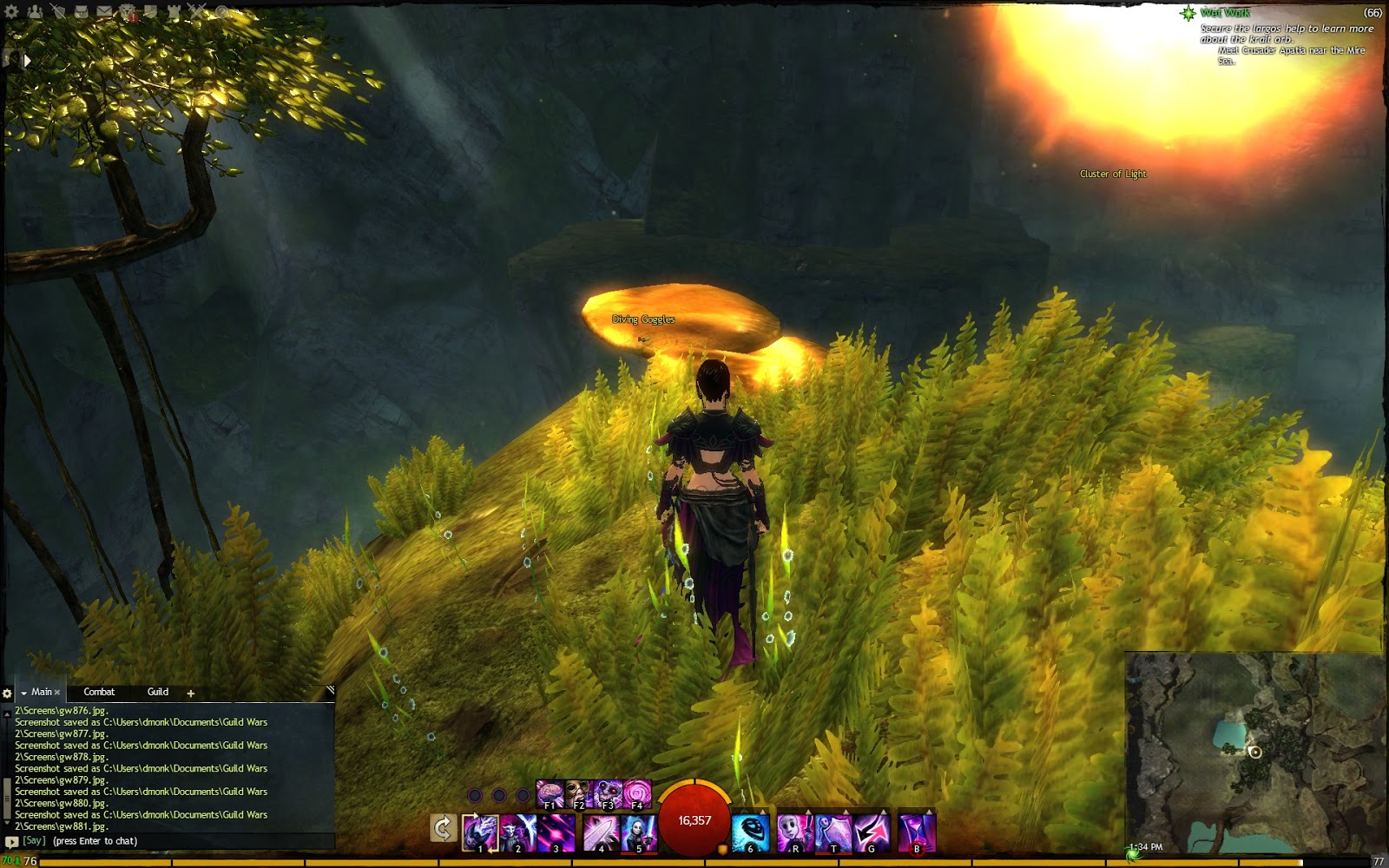

Plummeting into the water below, when you go to make your way out, there's only one way out of the pond. And though you don't know it at the time, you've been dropped into a location that is quite close to the fourth cantle - earth. All you have to do is walk around to the top of the pond, in either direction, and you'll immediately discover some earth elementals, and right next to them you'll see the Cantle of Earth.


 So where you go next doesn't matter too much, you've been given clues for both of the remaining cantles. As you stand there looking up at the very obvious Cantle of Water, you can see an opening in the back of the cliffs below the cantle - behind the waterfalls. And upon entering, you find yourself in a picturesque grotto, filled with wildlife, giant plants, and sparkling waterfalls. Now, I have to admit, I didn't pick up on the giant leaves right away. For whatever reason, unlike mushroom pads, which are clearly designed for jumping pads, the leaves to me seem like something that would give when you stand on it. But a little bit of experimentation, or perhaps another adventurer chancing by, and you quickly learn that the leaves are the key to this puzzle.


So that's that. I hope you enjoyed looking at the zone through a designer's perspective. And more importantly, I hope you gain some appreciation for the hard working guys and girls that develop that content. There is almost nothing that happens in these virtual worlds in which we play that happens completely by accident. That waterfall, that sweeping view, that fortuitous pool at the bottom of that cliff, those spiders you encounter along the way - all are there for a purpose. And somewhere, someone spent an extraordinary amount of time thinking about just exactly the right way to present that content so that you can enjoy it in the most satisfying of ways.
Wherever you're gaming, I hope you enjoy!
Sunday, July 1, 2012
Guild Wars' Curious Carry Mechanic

So, in most games, picking something up means simply that it goes in your inventory. And in Guild Wars, they have that kind of picking something up too. But they also have a whole different category of possession, which your character physically carries an item. You get an animation for it and everything. After you pick up the item, you are holding it in your hands. You get a special button that displays on your interface called "drop item". As you run around, you look pretty silly, carrying whatever it is, but there you are.
 |
| Carrying Buckets of Oil |
Hold Li Ming's ashes for 5...17...20 seconds. While you hold her ashes, conditions on you expire 10...42...50% faster. When you drop her ashes, all allies within earshot lose 1...3...4condition[s].
First, it's a bit morbid isnt it? But that's how it works. When you activate the spell, you're holding a little urn, which we can only presume are Li Ming's ashes. While you carry her ashes, you get a nice effect. Drop her ashes, and you get another effect. Why do you drop the item? Oh because while you're carrying an object, you can't use any of your abilities that require the use of your hands!
 |
| A Ritualist is never far from her handy collection of ashes! |
Around the time Eye of the North came about, they introduced a variation to the carry mechanic. They would give you an entirely new skill bar when you picked the item up. This is very similar to how vehicles work in WoW. Now - me personally, I'm not a huge fan of this either. You spend an extraordinary amount of time and effort putting together your build and acquiring your skills, and then you go and pick something up, and poof, all your skills are gone and replaced by some collection of things you didn't choose and most likely don't know. But it is what it is. The designers are fine with it, and the presumption is, you carry whatever it is enough, and eventually you'll learn those skills as well. And it does have the advantage at least of being equally fair regardless of what class you are.
This is, by the way, the version of the mechanic that lives on in Guild Wars 2. However, it seems in Guild Wars 2 that the designers have relagated carrying objects to somewhat of a pure flavor role. The world is filled with objects lying about just begging to be picked up, and when you do, you typically get some small collection of abilities that are associated with that object. But I haven't seen entire quests built around your ability to pick up an object, carry it somewhere, and put it down - no wait, you do have to pick up those water buckets in one of the first karma events - so yeah, I guess you are using them. Well at least there aren't entire classes built around using it as a mechanic.
One humorous anecdote to share, which is actually what prompted me to write this blog. In one quest in Eye of the North, your party is faced with an indestructible golem. However, it can be beaten by picking up a nearby object, charging said object up by interacting with a second object, and then putting the object down at the golem's feet. All the while the golem is hammering you with various attacks, and generally wrecking havoc with your party, while your party assails away at him to no avail. So I picked up the object, charged it up, but then I couldn't find the drop item button! I looked all over my interface and it wasn't there! So my poor heroes are fighting for their lives, healers trying vainly to keep people alive, warriors dying left and right, and Kaytte, prancing around like an idiot, carrying this stupid item, with all of the NPCs pleading for her to put it down, and her player going I can't find the button!! Thank gawd there were no actual other people in the party. Turned out it had appeared beneath one of the interface elements that you can move around. Once I moved the element out of the way, there it was. Kaytte deposited the charged thingamajig dutifully at the golem's feet, blowing it up.
Anyway, if Guild Wars 2 is actually your first foray into the world of Guild Wars, and you are wondering why there are cow paddies that you can actually pick up and throw - well now you know. Just one of the many quirks that came through from the original game, and lives on in its newest incarnation.
Tuesday, February 28, 2012
City of Heroes Peculiar Leveling

So surprisingly enough, lately I've found myself back in City of Heroes quite a bit. I blame my in-laws. They came up for a weekend recently, and we had all played City of Heroes back in the day. Now that the game is free-to-play, it didn't take long for them to re-activate their accounts, and after an hour or so patching up my computers, we had a nice six-man group running around completing missions and task forces - all of us playing in the same room, which makes for tons of hilarity and hijinks.
So I found myself logging in to play some more this past weekend. The game is fairly bustling with activity - the zones feel alive with people in them, the help channel is constantly busy with chatter, and after spending so much time in the vast emptiness of the upper level SWTOR zones (Voss and Correlia I'm looking at you), it felt good to play with people again. The only real caveats, of course, is that it is City of Heroes. You have to like the fundamental gameplay, which for many people feels staid and dated. And you have to be okay with, or at least be aware of, some of this game's own peculiar design quirks. And it's one of those that I wanted to talk about.
Wednesday, November 30, 2011
The Quest for the Perfect Quest

Sunday, August 28, 2011
Focus in Game Development
 |
| What's a camel? A camel is a horse put together by a committee.. |
This worked phenomenally well as the company was small, but as you can imagine, as the team size grew, it became exponentially difficult to reach design decisions that made everyone happy. And it became almost impossible for any singular vision of a particular game, or even of any particular portion of a game, to survive, as it weathered the brunt of multiple raging conference meetings and play sessions of people either championing or lambasting it. This was a pretty important lesson that I took with me from Ensemble. Shared design had its pros - those of buy in, participation, and a feeling of connection to the game. But it also had a pretty dark underbelly, as progress on the game could be significantly delayed when even the simplest of design decisions had to go through the company ringer and attempts to get buy in from everyone - whether they were involved or not.
So one of the things I was absolutely most excited about when I set about making Atomic City was that I could execute with focus. I may not have a big team to work on all of the aspects of the game, but I did have a singular vision. I could form a plan, execute the plan, and I could entirely avoid the days or even weeks of discussion that would inevitably accompany every decision made, as it would have been at my former employer. It may sound selfish, or a bit hedonistic, but when you've sat through those interminably long design meetings that consume entire days, and sometimes weeks, over whether or not Victory Points in an RTS are a good idea, it's hard to understate just how appealing the notion of making a decision and executing that decision is.
So, if you're a reader, then you know Atomic City started off as a prototype for an MMO. And I had a pretty solid definition of the set of design mechanics that would form the root of that MMO. And I was pretty darn excited about them, because they formed a carefully constructed blend of mechanics that were familiar to MMO players, but also presented some interesting innovations on some of those fundamental concepts. And history has taught us that small innovations to a core familiar gameplay are the key to a new MMO's success. At least, in my opinion. But when I didn't succeed in getting a publisher to byte on the MMO, I set about stage two of my business plan, which was to turn the prototype into a "small" singleplayer game for the PC, with a definite story - beginning, middle, end.
Now, I play a lot of City of Heroes. And there are quite a number of design tenets in CoH that I really like. And if you've played Atomic City, you have undoubtedly noticed City of Heroes' influence on that game's design. And for a significant portion of when I'm playing CoH, I often play solo. And so are a whole lot of other people I know. So honestly I wasn't too bothered about the idea of taking Atomic City's MMO prototype and turning it into a single player game. After all, it's exactly how I play most MMO's I play!
 |
| Original prototype, complete with ability bars |
And it was.. almost a complete disaster.
Because by far and away the biggest amount of feedback I got, from among that group, was that the core gameplay really.. just wasn't fun. Somewhere along the way, I had broken an implied promise that I had made to the player. I put a gun in their hand, but told them they didn't shoot it, they fired abilities to use it. And I put them on a vehicle that had guns attached to it, but I told them they didn't shoot those guns, they fired abilities that used those guns to do cool things. What was the most fascinating, was that those exact same mechanics, when presented in an MMO (CoH) that couched those weapons with other more "ability type things", like firing bolts of ice from your hand, worked just fine. The player was able to buy into that design mechanic in that game without problem. But when presented in a single player game that had its focus on shooting guns and getting on vehicles and shooting more guns - well players didn't want to fire abilities that used guns, and see Miss Miss Miss roll up over a fleeing mob's head. They wanted to point those guns at those mobs and hold the mouse button down until they were dead.
And suddenly, my game's much heralded tight focus wasn't worth shit. To make matters worse - it didn't test poorly with everyone. With people that typically didn't play video games, they loved it, because it was so gosh darn easy. You didn't have to put any crosshairs on anything. You pointed the vehicle in the general direction of a mob, pressed '1', and explody-shooty things happened and you felt really good! And those, honestly, were the type of people I wanted the game to appeal to. So I had actually succeeded in my goal - I had built a very casual friendly 3rd person RPG action game that involved weapons and hoverbikes and was fun for anyone that wouldn't normally play these games. But extraordinarily unfun for anyone that had ever picked up a game like this before, because of their already preconceived notions. Hell even I wanted to just shoot the gun at the mobsters, once I let myself think about it.
So I was faced with a huge dilemma. Monumental. Because you don't just wave a wand and fundamentally change the precepts and assumptions around which months and months of code was built. I had to decide - do I stick to my guns and finish the game as I had originally conceived it, or did I acknowledge the feedback I was getting, and undertake the monstrous task of fundamentally changing the game's core mechanics to make it more action oriented. Would I abandon my focus and do exactly the kind of thing I had railed on designers at Ensemble for doing.
Well if you've played the game, you know what I chose. Because the game didn't come out for another 8 months later, and the game is very much a 3rd person action shooter game, and all of those RPG mechanics were mothballed when I changed the game's design.
The moral, of today's parable, if you will, is that design fails when it's practiced at either extreme. When you have a company of even a few dozen people, much less a hundred of them, and you try to meet the needs of every one in the company in your design, your game is going to flounder in a morass of indecision, argument, discussion, and watered-down-compromise-based design. But if you build an entire game on a single person's vision, in what is essentially a design vacuum, you run real, genuine risk of building something that just isn't really, all that fun, or is going to do well. And that is easy to see when that single person is someone else and you're the one picking on his design. But it turns out it's quite a bit harder to see when that person is you.
I still don't know if I made the right decision for Atomic City Adventures. I feel like I did, because in the end I liked where Atomic City ended in terms of its design, and I feel like it's a helluva lot more fun than it was when I was "almost finished" back in November. And I'd be interested to hear what you think as well. And if you haven't played it yet, well for cryin' out loud go pick it up and give it a try! And come back and tell me what you think.
Subscribe to:
Posts (Atom)